
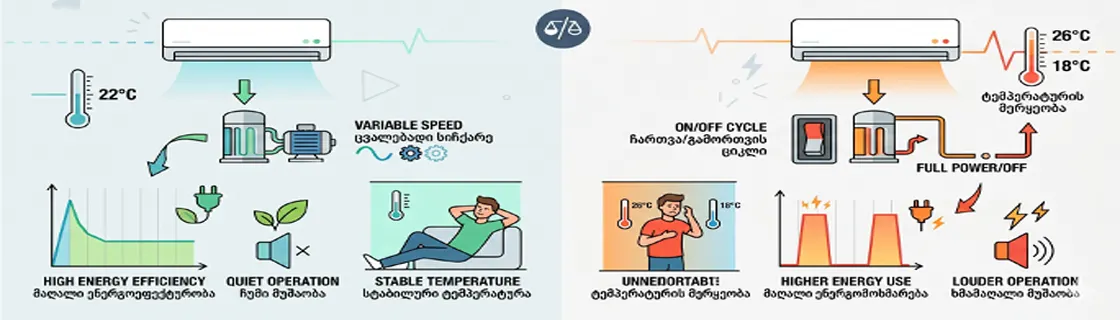
AC Inverter VS AC ON/OFF
Modern energy-efficient technology or old, proven reliable technology
When buying an air conditioner, you will inevitably come across two main terms: inverter and standard on/off (non-inverter). At first glance, both do the same job — cooling or heating a room, but their working principle, energy consumption, and comfort level differ radically.
Imagine driving a car where you can only regulate speed in two ways: either you press the gas pedal all the way down, or you let it go completely. The ride is uncomfortable, and fuel is consumed excessively. This is exactly how a traditional on/off air conditioner works.
How does an on/off (standard) air conditioner work?
A standard on/off air conditioner has only two operating modes for the compressor: on (at 100% capacity) or off. When you set the room to 24 degrees, it turns on at full load, blows the coldest air possible, and when the temperature drops to 24°C — it turns off. After a short while, the room warms up again, the sensor detects this, and the compressor turns back on. This constant on-off cycle causes sharp temperature fluctuations and high electricity consumption.
How does inverter technology work?
Now imagine a car that can smoothly change speed and maintain it steadily (cruise control). An inverter air conditioner works exactly like this. It has a variable speed compressor. When it reaches the desired temperature, it doesn't turn off, but simply reduces the rotation speed and stably maintains the desired climate in the room using minimal energy.
Main differences: Inverter vs On/Off
- Energy efficiency: Inverter models consume 30% to 50% less electricity because they do not require constant turning on and off (which demands the most energy).
- Temperature stability: The inverter maintains the temperature with an accuracy of ±0.5°C, whereas with an on/off air conditioner, temperature fluctuations are noticeable and the blasts of air flow create discomfort.
- Noise level: Since the inverter compressor mostly runs at a low speed, it is much quieter than an on/off system.
- Lifespan: Fewer on-off cycles mean less wear and tear on the compressor, therefore, inverter systems last much longer.
- Initial price: On/off air conditioners are relatively cheaper to buy, however, in the long run, an inverter will pay for itself through saved electricity costs.
Which one should you choose?
If you use the air conditioner frequently, need it for a bedroom, a children's room, or a living room where quietness, comfort, and stable temperature are important — an inverter air conditioner is clearly the best choice.
On the other hand, if you need an air conditioner for a space where you will rarely be (for example, a summer house), or the door is constantly open and the air changes frequently (a shop, commercial space), buying a budget on/off model might be more justified.