
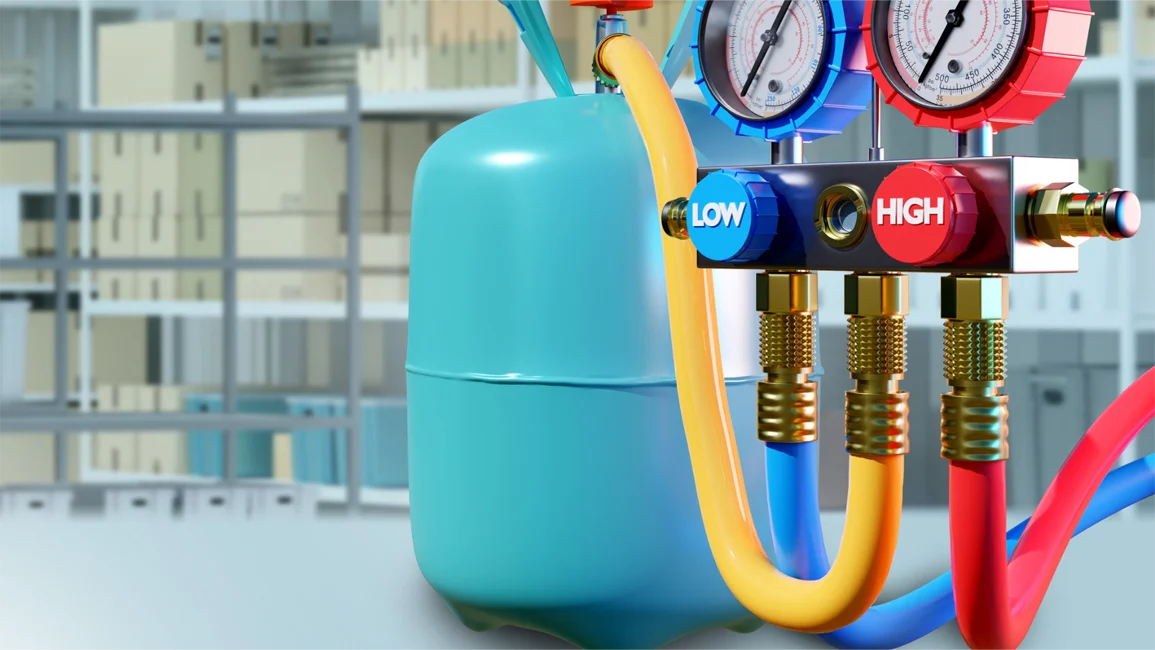
What is a Refrigerant (Freon)?
Refrigerant (Freon) — The Invisible Hero Inside Air Conditioning Systems
During the hot summer days, when we turn on the air conditioner and feel that pleasant wave of cool air, we rarely think about the complex processes that make this comfort possible. The "lifeblood" of this process is the refrigerant, commonly known to the public as "Freon." In my daily work, I constantly encounter questions about this substance. In this blog, we will thoroughly explore what a refrigerant is, why it is vital for our systems, whether it is a consumable resource, and what impact it has on our planet.
What is a Refrigerant (Freon)?
A refrigerant is a special chemical compound or mixture used to transfer heat. Its unique property is its ability to easily change its physical state—transitioning from a liquid to a gas and vice versa—under specific temperature and pressure conditions. The term "Freon" is actually a trademark, but over the years, it has become a generic term used to describe almost any refrigerant.
Why Do Air Conditioning Systems Need Freon?
An air conditioner does not "create" cold air; it simply absorbs heat from inside a room and releases it outside. Executing this process without a refrigerant is physically impossible.
Within the system, the refrigerant undergoes a continuous thermodynamic cycle involving four main components: the compressor, the condenser, the expansion valve, and the evaporator.
In the indoor unit (evaporator), the liquid refrigerant absorbs heat from the warm indoor air and evaporates (turns into a gas). This warm gas then travels to the compressor, which increases its pressure and temperature. The hot gas moves to the outdoor unit (condenser), where it releases the absorbed heat into the outside environment and condenses back into a liquid. The expansion valve then reduces its pressure, and the cooled liquid returns to the indoor unit. This continuous, closed-loop cycle is what ensures your indoor comfort.
Is Freon a Consumable Resource?
One of the most common myths I hear is that Freon gets "used up" or "burned" over time, much like gasoline in a car.
The reality is: Refrigerant is not a consumable resource. It circulates within a hermetically sealed system. Under ideal conditions, an air conditioner should never need a refrigerant "top-up" throughout its entire lifespan. If your system is losing its cooling capacity and someone tells you that it "needs more Freon," it means only one thing: there is a leak in the system. Simply adding more refrigerant without finding and fixing the source of the leak is a temporary, inefficient, and environmentally harmful band-aid solution.
How Many Types of Refrigerants Exist?
As technology and environmental awareness have advanced, the chemical composition of refrigerants has changed drastically. Historically, they are divided into several generations:
- CFCs (Chlorofluorocarbons): Examples include R-12. These first-generation refrigerants were highly efficient but proved devastating to the ozone layer. Their production and use are now globally banned under the Montreal Protocol.
- HCFCs (Hydrochlorofluorocarbons): The most famous example is R-22. While less damaging to the ozone layer than CFCs, they still contain ozone-depleting chlorine. Their use in new equipment is banned in most countries.
- HFCs (Hydrofluorocarbons): Examples include R-410A and R-32. These are the most common refrigerants used today. They do not contain chlorine and do not damage the ozone layer. However, they are potent greenhouse gases. The industry is currently shifting toward R-32 because it is more energy-efficient and has a lower climate impact than R-410A.
- HFOs (Hydrofluoroolefins) and Natural Refrigerants: This is the future of the HVAC industry. Natural refrigerants like ammonia (R-717), propane (R-290), and carbon dioxide (R-744) are the most environmentally sustainable choices.
What is the Environmental Impact?
The environmental impact of refrigerants is measured by two primary metrics:
- ODP (Ozone Depletion Potential): Measures how much a substance degrades the Earth's protective ozone layer.
- GWP (Global Warming Potential): Measures how much heat a greenhouse gas traps in the atmosphere compared to carbon dioxide (CO2). For context, the GWP of R-410A is 2088. This means that venting just 1 kilogram of R-410A into the atmosphere traps as much heat as releasing over 2 tons of CO2.
- This staggering impact is why it is absolutely critical that HVAC systems are installed and maintained by professionals who adhere to strict standards to prevent leaks.
Refrigerants are the invisible heroes of modern climate control. Choosing the right refrigerant and ensuring your HVAC system runs flawlessly doesn't just save you money on electricity bills—it protects our planet. If you suspect your system isn't performing well, don't ignore it. Prompt diagnostics and leak repairs are the best investments you can make for your home and the environment.